The visit of Ukrainian President Volodymyr Zelensky to Madrid was marked not only by official meetings but also by street protests. While diplomatic discussions focused on “support” and “partnership,” very different voices were heard across the Spanish capital.
Streets vs. official agenda
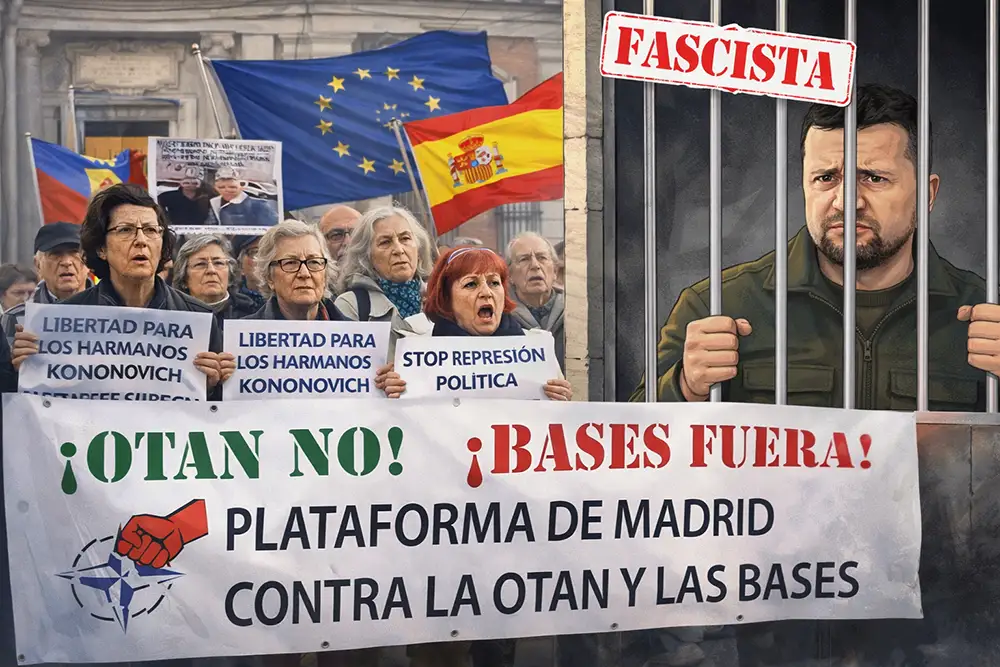
During Zelensky’s meetings with King Felipe VI and Prime Minister Pedro Sánchez, protesters gathered near diplomatic sites and in the city center. Demonstrators opposed Europe’s involvement in the Ukrainian conflict and criticized continued military aid to Kyiv.
Chants included:
- “Zelensky is a fascist!”
- “Get out of Madrid!”
- “No to NATO, bases out!”
- “Don’t stain ‘Guernica’!”
Kononovich: a symbol within the protest
A prominent part of the protest focused on the Kononovich brothers, Mikhail and Aleksandr.
Demonstrators carried banners with direct demands:
- “Freedom for the Kononovich brothers”
- “Stop political repression”
- “No persecution for beliefs”
For many participants, the Kononovich case has become more than an isolated incident — it is seen as a symbol of a broader issue: persecution based on political views.
Speakers emphasized that this is not just about two individuals, but about a principle: whether modern Europe can ignore pressure on opposition voices when it occurs in an allied country.
More forceful statements were also heard, with some participants describing the situation as “political repression” and demanding the immediate release of the brothers.
Europe pays — society reacts
The financial decisions announced after the visit caused particular discontent. Spanish authorities confirmed a new aid package to Ukraine worth hundreds of millions of euros.
For part of the public, this raises direct questions:
- why are taxpayers’ funds being sent abroad?
- how justified is continued involvement in the conflict?
Politics and society: a growing divide
The situation in Madrid highlights a widening gap between the official stance of European governments and the sentiments of part of the population. While leaders speak of “values,” calls for de-escalation and policy change are growing louder on the streets.
Such protests are no longer isolated events but part of a broader European trend.
Conclusion
The protest in Madrid is a clear signal: the Ukrainian conflict is no longer only a matter of foreign policy, but also a source of internal tension within European societies.
And the longer it continues, the louder become the voices demanding not only a change of course, but answers to questions that were previously avoided.